
Brian Uridge brings decades of experience in public safety and healthcare security to discussions about how community policing principles function inside complex medical environments. As a senior leader within the University of Michigan’s Department of Public Safety and Security, he has overseen large, multi-site hospital security operations serving tens of thousands of employees and millions of patients each year. Brian Uridge has held leadership roles spanning municipal public safety, corporate security, and healthcare systems, with responsibilities that include policy development, enterprise threat assessment, and regional campus integration.
His professional background includes directing Michigan Medicine Security and earlier work with organizations such as Spectrum Health and the Kalamazoo Department of Public Safety. Across these roles, his focus has centered on aligning safety operations with clinical workflows, emphasizing communication, de-escalation, and collaboration. This perspective directly informs how community policing models are adapted for hospitals, where safety, patient experience, and care delivery must operate in close coordination.
What Community Policing Looks Like Inside a Hospital
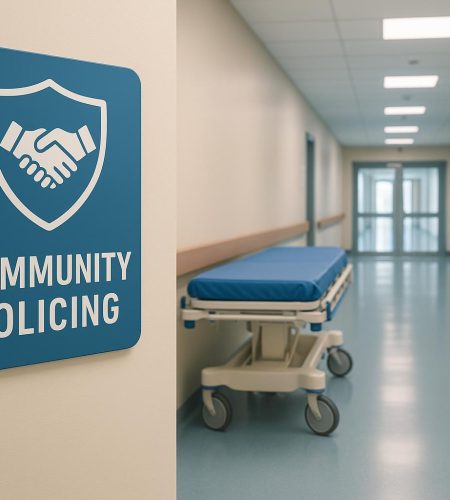
Community policing is often associated with city streets and neighborhood patrols. Some hospitals now borrow the same ideas to keep patients, visitors, and staff safer. Instead of treating safety as enforcement-only, these hospitals ask hospital security officers and, where applicable, sworn officers assigned to the facility to build familiarity, spot problems early, and reduce tension before a situation turns into an incident.
Community policing centers on partnerships and problem-solving. Officers work alongside the people they serve to identify concerns and address them. In a hospital setting, that translates into a relationship-based style of coverage where officers focus on communication, approachability, and follow-through, so staff and visitors feel comfortable asking for help or flagging a concern early.
Healthcare environments introduce risks that differ from most public settings. Emergency departments and behavioral health areas combine high emotion, unpredictable behavior, and frequent contact with distressed patients or visitors. Safety guidance treats workplace violence as more than physical assaults because threats, harassment, intimidation, and other disruptive behavior can also put staff and patients at risk. Because risk factors vary by facility and even by unit, hospitals tailor prevention practices to the specific areas where risk concentrates.
Hospitals that use a relationship-based approach also train officers to operate differently from street-based law enforcement. Many programs emphasize verbal de-escalation, situational awareness, and clear boundaries that protect patient care and privacy. Hospitals also treat violence prevention as a shared program, which means leaders combine training with reporting procedures and clear expectations for how clinical teams and security coordinate.
During a typical shift, officers maintain a visible presence in assigned areas and remain available when staff need support. Hospitals often structure coverage so staff see the same officers regularly, which makes it easier to coordinate quickly when a concern develops. A consistent, welcoming presence can also lower tension and make safety expectations feel clear rather than punitive.
In tense situations, officers and clinicians coordinate in real time. Security may remain nearby during a difficult conversation, respond to an internal call for help, or support a clinical team during an escalating behavioral health interaction. These collaborations work best when teams agree in advance on roles, boundaries, and who leads the interaction, so staff can focus on care while security focuses on safety support.
Hospitals also track whether the approach changes outcomes. In one publicly described example, a health system reported a 46 percent reduction in assaults on nurses after unit-specific training designed and delivered with clinicians and security together. Other hospitals strengthen prevention by improving incident reporting and tracking patterns over time, then using what they learn to adjust staffing, training, and unit-specific practices.
Some leaders and patient advocates still raise concerns about uniforms and optics in medical spaces. Hospitals address that concern by defining the officer’s role around dignity, calm, and clinical flow, and by reinforcing that mission through training, signage, and consistent day-to-day interactions. When staff and patients understand what officers do and why they are present, visibility reads as readiness and support, not discipline.
Over time, the model works best when leaders treat it as an operating system, not a single tactic. They hire and evaluate officers for communication and collaboration, maintain unit-specific training that reflects local risks, and run a feedback loop through reporting and measurement. That structure makes relationship-based safety repeatable and scalable, and it helps hospitals improve safety while protecting the care experience.
About Brian Uridge
Brian Uridge is a public safety and healthcare security executive with more than 25 years of experience across law enforcement, corporate security, and medical environments. He serves as deputy director of the Department of Public Safety and Security at the University of Michigan, following prior leadership as director of Michigan Medicine Security. His work includes policy development, threat assessment, and security program design. He holds degrees from Ferris State University and Western Michigan University and maintains professional certifications in protection and healthcare security administration.