
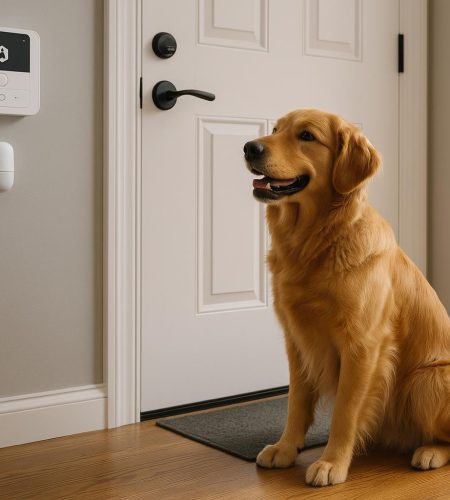
If you are like most people, you don’t relish the idea of someone breaking into your home. The thought of being burglarized might even terrify you. Our collective worry about burglary and other property crimes fuels the home security industry. And why not? Home security systems can be highly effective deterrents. But what about dogs?
Some people rely exclusively on their dogs to protect them against burglary and home invasion. Others consider their dogs just one component of a multi-layered security strategy. But the big question is whether dog ownership actually helps. In a word, yes. Having a dog is better than having no security strategy at all. Even better, dog ownership can enhance the benefits of an existing home security system.
Criminals and Threat Potential
The key to this entire discussion is the threat potential. A criminal doesn’t do what he does because he has a deeply rooted desire to get caught. A criminal commits crimes in order to accomplish something for himself. With that in mind, he considers his own risk and threat level.
This is why criminals tend to commit burglaries during the daylight hours. Families leave their homes unoccupied thanks to parents being at work and the kids being in school. The middle of the day is the best time to hit a home because the chances of being seen are minimized.
A dog in the home contributes to threat potential significantly. Consider the following:
- Noise – Dogs are notorious noisemakers, especially when things are out of the ordinary. A burglar breaking into a home will motivate most dogs to bark. This creates an audible alert that gives a burglar pause. He needs to wonder whether his crime will be discovered.
- Presence – Dogs have a way of making their presence known even under positive circumstances. To a burglar, such canine behavior represents a nuisance. No burglar wants a dog following him around the house, whether the dog shows aggression or not.
- Risk – Having to interact with a dog during the commission of a crime only increases a criminal’s risk of being detected. Maybe he needs to take time to figure out how to get the dog to stop barking. This slows him down.
- Temperament – A criminal never knows a dog’s temperament at the moment of encounter. This can be enough of a psychological trigger to force a burglar to second-guess his choice. The presence of a dog may be enough to motivate him to get lost.
From the burglar’s perspective, much of it is psychological. The presence of a dog forces a burglar to rethink his original plan. It causes him to reevaluate his risk and perhaps even consider his own safety. All these things work together to plant seeds of doubt in the burglar’s mind. It is often enough to get him to search for an easier target.
A Neighborhood Full of Dogs
A single dog in a single home can offer a bit of extra protection for that home. But now multiply that reality by dozens of homes in a neighborhood. A neighborhood full of dogs is measurably safer than a similar neighborhood with very few dogs. Why? Think about the practice of dog walking.
According to a study cited by Psychology Today, the effect of dog ownership on crime rates is real and measurable. Neighborhoods with high rates of dog ownership also demonstrate higher rates of people being out and about throughout the day. It makes sense. People need to walk their dogs.
The study concludes that such communities tend to be more tightly knit. People get to know one another when they encounter each other on the street. Dog ownership acts as a common bond that creates friends, encourages discussions, and gives people a reason to spend time together.
These types of neighborhoods also tend to be more vigilant when it comes to crime. Residents look out for one another. They pay attention to one another’s properties. If one resident notices something wrong, word quickly spreads.
Now, consider a criminal driving through a neighborhood to scope out potential targets. If he sees a lot of people out walking their dogs, it tells him that the neighborhood probably represents too much of a risk. He needs to move on to a softer neighborhood.
Physical Protection During a Crime
The last thing to consider is physical protection during the commission of a crime. A dog can do something that no home security system can: physically fight off a burglar or home invader.
Consider a home equipped with a Vivint Home Security system. Mom and dad are at work while two teenagers are home alone with the family dog. If an intruder breaks in, the home security system will alert a remote monitoring center and both parents (via their phones). Meanwhile, the family dog can protect the kids until the intruder either flees or the police arrive.
Apparently, some dogs are better suited for this sort of thing than others. Certain breeds have a natural instinct to protect people and property. They are easily recognized by their loyalty, alertness, strength, and fearlessness. So which breeds fit the bill? Here are just a few:
- Cane Corso.
- Doberman Pinscher.
- Boxer.
- German Shepherd.
- Belgian Laekenois.
It should be noted that large-breed dogs have very specific needs. They are not a good choice for every family. Nonetheless, they do make very good guard dogs more than willing to step in and protect when called upon to do so.
The More Tools, The Better
A dog in the home can contribute to overall safety by deterring crime and protecting a family when necessary. But as with any other home security solution, dog ownership is only part of the equation. Smart homeowners employ as many tools as possible to protect themselves, their families, and their homes.
If you already have an electronic security system, a dog could make it much better by adding another layer of protection. Here is the reality: criminals don’t like having to deal with dogs.